
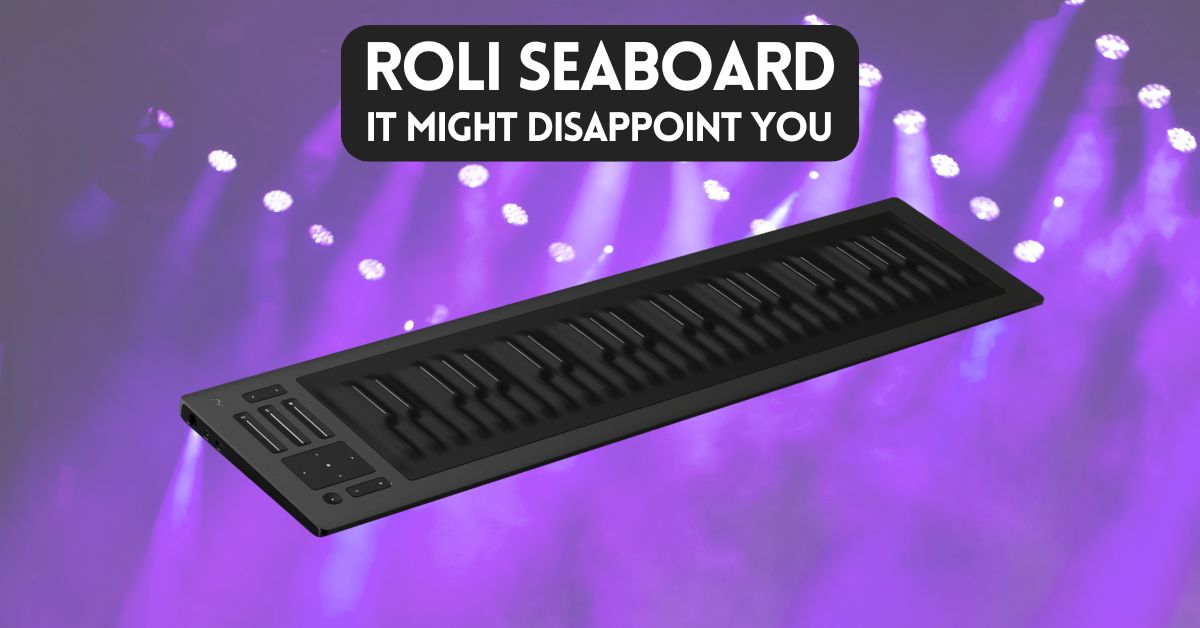
You might have a disappointing experience with the Roli Seaboard. It happened to me right after I unboxed it.
Azure Hills Music contains affiliate links and is a member of the Amazon Services LLC Associates Program. As an Amazon Associate, we earn from qualifying purchases at no extra cost to you when you purchase using one of these Amazon links. Read our disclaimer and privacy policy for more information.
Watch The Video – Why The Roli Seaboard Might Disappoint You
Inspiration To Purchase My Roli Seaboard
When I first got my Roli Seaboard, I was incredibly excited. I had seen countless amazing YouTube performances that made the instrument seem revolutionary. If you haven’t watched Jordan Rudess shredding on the Seaboard, those videos are worth finding—they’re truly impressive. After seeing these stunning demos and learning about the board’s MPE capabilities, I took the plunge without ever laying a finger on one.
But once I plugged it in and started playing, my first impression was pure disappointment. From a distance, the Seaboard looks like a piano keyboard. As soon as you touch it, however, you realize it feels nothing like one. My first attempt was to play a few simple chords. How hard could that be? The result was an out-of-tune mess. I couldn’t figure out what was happening.
That was my first learning moment. I realized the pitch layout is fluid. On a regular keyboard, your finger can land anywhere on a key—center, left, right, top, or bottom—and you’ll get the same pitch. On the Roli Seaboard, even a minor deviation from the true center of a note can produce unexpected results. My first takeaway was clear: this was going to take work. It really is a unique and different instrument.
First Impressions: A Shock to the System
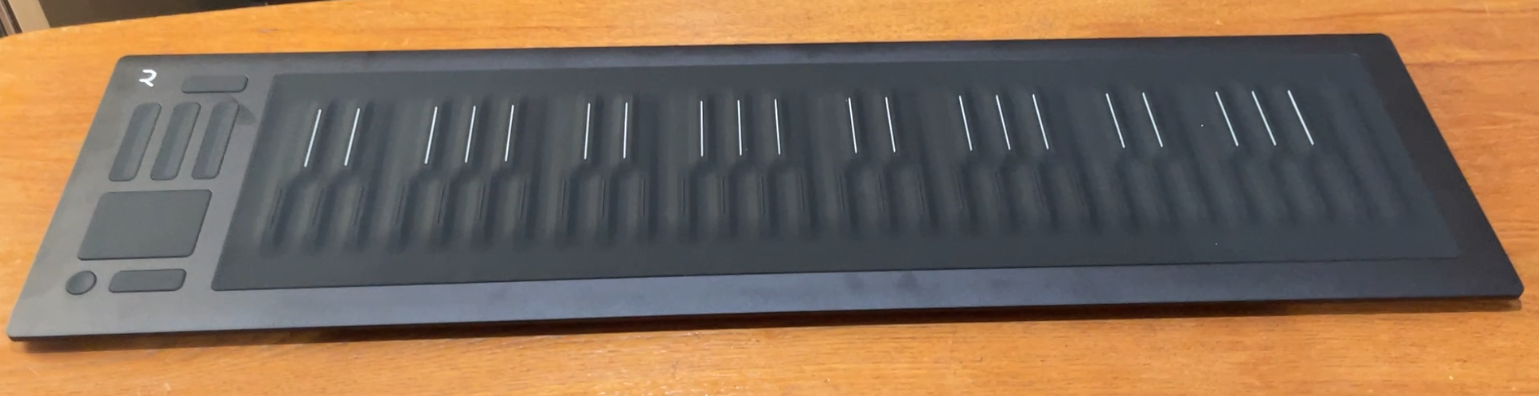
Let’s talk about the tactile experience. The soft, squishy surface is completely different from the defined, hard keys of a piano. If you expect to transition smoothly from your piano technique to this instrument, prepare yourself for a shock.
Traditional pianos and keyboards offer firm keys, predictable touch, and a solid structure under your fingers. The Seaboard, on the other hand, is more like a fretless instrument. There are no rigid divisions between notes, and your finger placement requires a new level of precision. Sliding, bending, and subtle finger movements are the heart of this instrument. If you approach it with a pianist’s mindset, it can feel alien—and frankly, frustrating—at first.
But this is also where the opportunity lies. This board truly shines with fluid musical lines that benefit from natural-sounding pitch variations. Think of string instruments, from violins to guitars. If you’ve ever struggled to emulate the synth pitch-bending style of Jan Hammer on a standard keyboard, this board might be your answer. Bending and sliding notes on the Seaboard feels far more natural than with any pitch wheel or joystick I’ve ever used.
The Challenge and Magic of MPE
This is where the magic—and the challenge—begins. The Seaboard is built around MIDI Polyphonic Expression (MPE). This technology allows every single note to have its own independent pitch bend, vibrato, timbre changes, and dynamics, all controlled by your finger movements.
- Press (Strike): The initial force of your finger on the keywave.
- Glide (Pitch Bend): Sliding your finger left or right to bend the pitch.
- Slide (Timbre): Moving your finger up and down the keywave to alter the sound’s character.
- Lift (Release): The speed at which you release the keywave.
However, you can’t exploit these features immediately. It takes dedicated practice to train your hands to control these subtle expressions. When you connect the Roli to MPE-compatible sounds, a new world of expression opens up. Tap a note for a basic tone. Move your finger back and forth for a beautiful, natural-sounding vibrato. Slide your finger from the bottom of the note toward the top, and depending on the sound’s programming, you might trigger a change in timbre.
There are new sound-shaping possibilities at your fingertips, but to truly master them, you need to put in the time. This steep learning curve is why so many musicians feel let down in the beginning.
Why You Might Feel Disappointed
So, why might you be disappointed with the Seaboard? It often comes down to mismatched expectations. Here’s a quick summary:
- It doesn’t feel like a piano. The soft, continuous surface is a world away from traditional keys.
- It requires a new playing technique. Your muscle memory from years of playing the piano won’t directly translate.
- The learning curve is notable. It can take weeks or even months before you feel comfortable and in control.
- The magic isn’t instant. It’s easy to expect amazing results out of the box, but in reality, this is an instrument you have to grow into.
My advice? Try before you buy. With the decline of brick-and-mortar music stores, auditioning gear is harder than it used to be. But because this instrument is so different, it’s worth seeking out a place to try it before you commit.
The Payoff: A ‘Fretless Keyboard’
Here’s the twist: once you put in the time, the Seaboard becomes something truly unique. I now call it my “fretless keyboard” because it lets me do things no other instrument in my collection can. The ability to bend notes, glide between pitches, and control expression in real time opens doors to sounds and performances that just aren’t possible on a traditional keyboard.
It has become a go-to instrument for my recordings. I’ve even modified my DAW template to include dedicated tracks for MPE sounds played on the Roli. This board has allowed me to record lines that I never would have executed the same way on a standard keyboard. While my very first impression was disappointment, today I cherish this board as one of the most creative tools I own.
Is the Roli Seaboard for You?
If you’re considering a Roli Seaboard, know this: it’s not a plug-and-play piano replacement. It’s a brand-new instrument with its own rules.
Yes, you might be disappointed at first because it is so different. But if you can get past that initial moment and are willing to learn how to get the most out of it, you might find it becoming a cornerstone of your creative setup. It challenges you to think differently about expression and phrasing, pushing you into new musical territory.
Have you played the Roli Seaboard? I’d love to hear about your experience. Leave your thoughts in the comments section below.
Thanks for stopping by to read this article.
Arthur Dobrucki
Azure Hills Music