
Walking up to an unfamiliar organ console can feel like encountering a complex musical puzzle. Each instrument has its own voice, personality, and secrets waiting to be discovered. Whether you’re a seasoned organist facing a new church position or exploring a historic instrument for the first time, the approach you take in those crucial first moments will shape your entire relationship with the instrument. In this article, we’ll look at how to meet a new organ for the first time.
Getting to know one stop is like getting to know a friend. Getting to know all the stops on a keyboard is like getting to know a family. Getting to know more than one keyboard is like getting to know the neighborhood. This methodical exploration transforms what could be an overwhelming experience into an exciting journey of musical discovery.
The key lies in patience and systematic exploration. Rather than pulling out all the stops at once, seasoned organists understand that each voice deserves individual attention before joining the ensemble. This careful approach reveals the instrument’s true character and helps you make informed musical decisions from your very first service.
Azure Hills Music contains affiliate links and is a member of the Amazon Services LLC Associates Program. As an Amazon Associate, we earn from qualifying purchases at no extra cost to you when you purchase using one of these Amazon links. Read our disclaimer and privacy policy for more information.
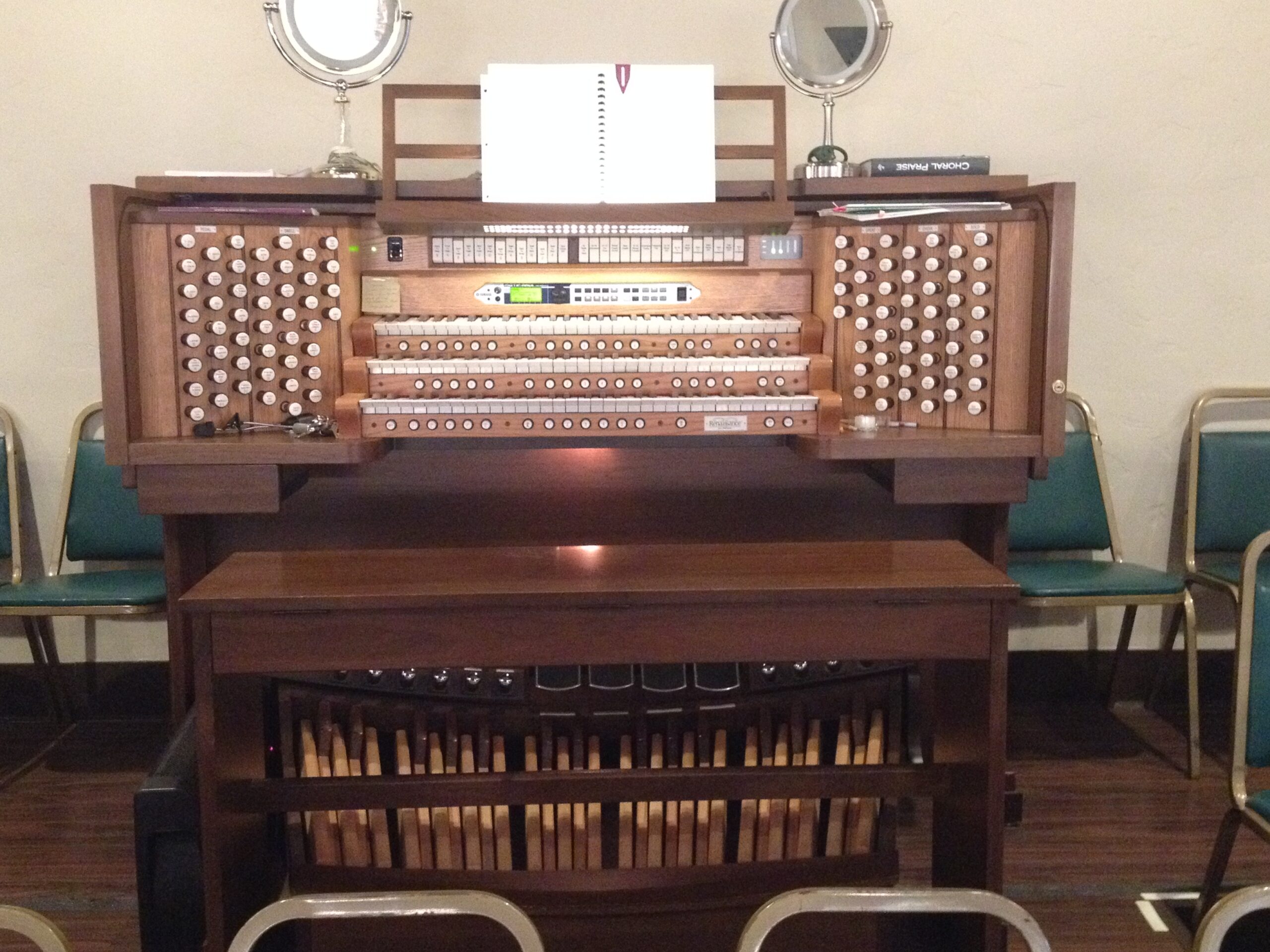
Start with the Swell Division
Step 1: Begin with the Swell – Listen to each 8′ voice by itself, asking these essential questions:
When playing chords, is the melody clearly audible? If you can’t pick out the melody of a hymn, neither can the congregation. This fundamental question guides every registration decision you’ll make on this instrument.
Do any ranges, especially the tenor and alto ranges, blot out the melody? This consideration proves just as important with solo organ music as for accompanying. The organ’s primary role is to support and enhance musical expression, never to overshadow it.
Does a 4′ or 2′ voice sound too loud in the tenor range below middle C, obscuring the melody in the right hand? This common issue can derail even the most carefully planned registration.
Is each stop well balanced from lowest to highest notes? Consistency across the keyboard range ensures smooth musical lines and predictable dynamic control.
Most importantly: Do you like what you hear? Music engages both emotion and intellect, and your personal response to each voice matters tremendously.
Building Dynamic Progression
Next, check the progression of voices from softest to loudest. A typical progression might include:
- Viola 8′
- Flute 8′
- Flute 4′
- Principal 8′
- Principal 4′
- Flute 2′
- Mixture IV
- Oboe 8′
- Trumpet 8′
Ask yourself: Is the Swell loud enough? Can this division provide adequate support for congregational singing? Is the build-up smooth, or do certain stops sound much louder than others, disrupting the instrument’s balance?
Why begin with the Swell? Because it’s typically the smaller division in a two-manual organ, and because it contains stops particularly useful for accompanying singers. Listen carefully to how smoothly the swell shutters function—this expression mechanism will become your most important tool for dynamic control.
Note: If the organ follows Baroque German or French design principles, consider beginning with the Gedeckt/Bourdon 8′ on the Positiv manual instead.
Exploring the Great Division
Step 2: Think of the Great in the same progression from soft to loud
Apply the same methodical questioning: Is the melody clearly heard in the soprano? Does each stop maintain consistent loudness up and down the keyboard? Does each addition contribute the right amount of sound without overwhelming the ensemble?
The Great division typically serves as the organ’s foundation, providing the backbone for hymn accompaniment and the power for festive music. Understanding its character and capabilities will inform your registration choices for years to come.
Integrating the Pedal Division
Step 3: Using the Pedal – Since normal pitch for the Pedal matches the manuals at 8′, begin by drawing the Swell-Pedal 8′ coupler before using any actual Pedal stops. Never play a Pedal 16′ stop without an 8′ foundation—well, almost never.
Add the Pedal 16′ stops following the same dynamic progression used for the manuals. Is the softest Pedal 16′ gentle enough to support the quietest Swell 8′ voice?
Critical consideration: Deep bass tones from 16′ Pedal stops often sound louder from a distance than they do at the console. Therefore, evaluate all 16′ Pedal voices from out in the room, not from the organ bench. What seems balanced at the console may overwhelm the congregation.
Testing Full Organ Combinations
Step 4: Try various organo pleno or tutti combinations
Experience the organ’s full voice by asking: Is it exciting or tiring? Grating or invigorating? Can you clearly distinguish individual parts, especially the soprano line? Does the Great truly stand above the other manuals? Is the Pedal strength and depth appropriate for the room?
This full-organ exploration reveals the instrument’s ultimate capabilities and helps you understand its role in the worship space.
Understanding Voice Relationships
Step 5: Contrasts in similar voices
Many organs feature multiple voices of the same pitch and family. If an organ includes two Principal 8′ voices—one in the Swell, another in the Great—evaluate each individually. Is each pleasant enough for solo use? Can one effectively accompany the other?
Consider an organ with four stopped flutes: Rohrflöte 8′ (medium diameter capped pipe with chimney), Bourdon 8′ (medium or larger diameter, no chimney), Gedeckt 8′ (smaller diameter, no chimney), and Quintaton 8′ (smallest diameter, no chimney). Does each sound distinctly different from the others? Are the volume levels balanced so one can accompany another? Can you create a satisfying progression using only these voices?
The Art of Color and Dynamic Balance
Progression and variety often result as much from color changes as from volume differences. The Hauptwerk of the historic organ at Matthews Memorial Presbyterian Church in Albany, Texas, exemplifies this principle beautifully. Each voice maintains approximately the same volume as the others, yet any two can combine effectively because of their distinct timbral characteristics.
This approach to organ design emphasizes the importance of listening for color relationships, not just dynamic levels. Understanding these subtleties will enhance your registration creativity and musical expression.
Your Next Steps in Organ Discovery
Meeting an organ for the first time marks the beginning of a lifelong musical relationship. Each instrument teaches unique lessons about sound, space, and musical expression. The systematic approach outlined here provides a foundation for understanding any organ, from intimate chamber instruments to grand cathedral organs.
Remember that this initial exploration represents just the beginning. As you spend more time with an instrument, you’ll discover subtle voice combinations, perfect expression levels, and ideal registrations for specific musical moments. The organ will gradually reveal its secrets, rewarding your patient attention with years of musical partnership.
Take time to document your discoveries. Note successful registrations, problematic voice combinations, and the instrument’s particular strengths. This information will prove invaluable as you develop your relationship with this unique musical voice.
Thanks for reviewing this article on meeting an organ for the first time.
Arthur Dobrucki
More Organist Articles
Recommend Books For An Organist’s Library
Debunking Pipe Organ Myths
Wedding Organist Guidelines – From Fees to Practices