
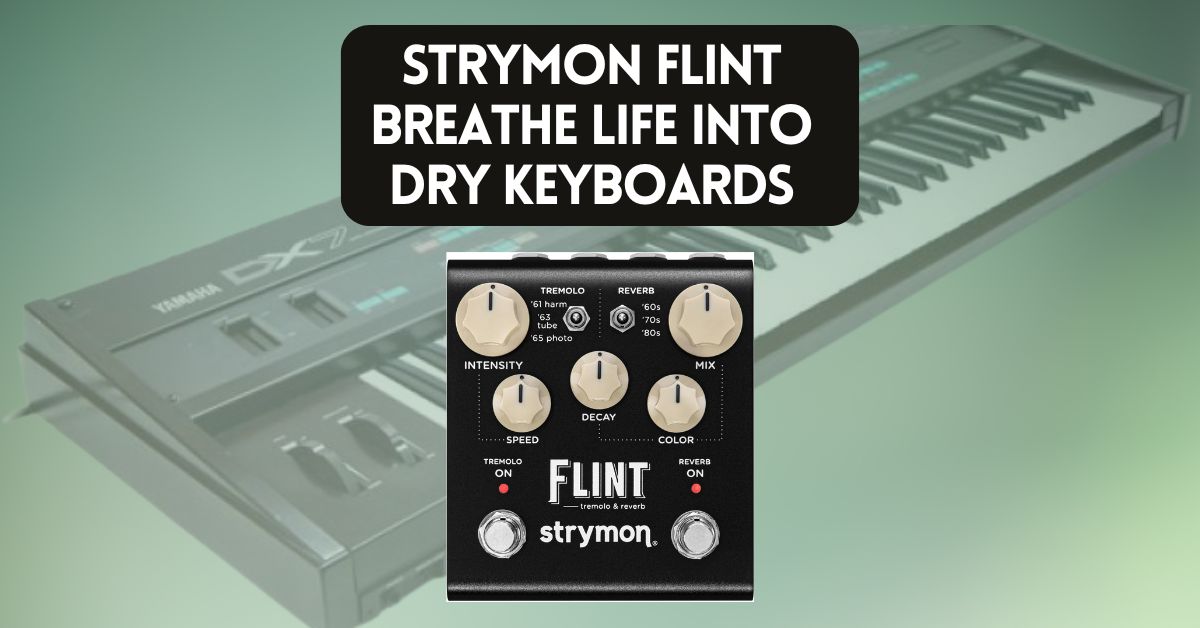
Early synthesizers earned their reputation for revolutionary analog sounds. Even through the early digital synthesizer era, the Yamaha DX7 was noted for its groundbreaking FM synthesis and iconic presets that defined the sound of the 1980s. Yet despite these impacts, such synthesizers had one notable limitation—they produced completely dry audio signals without any built-in effects processing. A Strymon Flint pedal paired with a dry synth is one solution to breathe life into a dry sound.
This characteristic, while maintaining the purity of their synthesis engines, can make even the most carefully programmed patches sound sterile or thin compared to modern instruments with onboard reverb, chorus, and delay circuits. The solution? External effects processing that transforms those pristine synthetic tones into rich, expressive sounds that command attention in any mix.
In this article, I’m focusing on pairing the Strymon Flint pedal with synthesizers. It offers an elegant solution, combining vintage-style tremolo and reverb effects that can breathe new life into your synthesizer’s output. This boutique effects processor draws inspiration from classic 1960s to 1980s amplifier and studio sounds—the perfect complement to the early synthesizer retro aesthetic.
I recently spent time pairing the Styrmon Flint with my Yamaha DX7iiFD synthesizer, so much of the discussion below references this pairing. Still, the points raised below largely apply to most synthesizers and keyboards that don’t have internal effects.
Azure Hills Music contains affiliate links and is a member of the Amazon Services LLC Associates Program. As an Amazon Associate, we earn from qualifying purchases at no extra cost to you when you purchase using one of these Amazon links. Read our disclaimer and privacy policy for more information.
Why External Effects Transform Dry Synthesizers
Synthesizers without internal effects processing, particularly vintage digital instruments like the DX7, face inherent challenges in modern musical contexts. Their raw outputs often lack the warmth, depth, and spatial presence that listeners expect from contemporary productions.
External effects processors provide essential creative control that goes far beyond what built-in circuits typically offer. You can select specific processors that match your sonic vision, adjust parameters in real-time during performances, and create unique textures that distinguish your sound from other musicians using the same presets.
Effects such as reverb add crucial spatial dimensions to sterile digital tones, while tremolo introduces rhythmic movement that can transform static patches into dynamic, breathing sounds. These processors open vast possibilities for sound design, allowing you to craft ambiences that range from subtle enhancement to dramatic transformation.
Early Synthesizer Sound Limitation
Many synthesizers, including the Yamaha DX7, lacked internal effects. For the DX7, this represents both its greatest limitation and one of its enduring strengths. This design choice kept the instrument focused on its core FM synthesis capabilities while maintaining signal clarity that many modern synthesizers sacrifice for convenience.
However, this pure output can sound flat or less engaging when compared to instruments with built-in processing. The raw digital tones, while technically precise, often need external enhancement to achieve the warmth and character that make them truly musical. It’s one of the reasons some keyboardists use to argue that the Yamaha DX7 is an overrated keyboard.
Adding outboard gear becomes essential for unlocking the DX7’s full potential, allowing you to add personality and dimension to even the most basic patches. This approach also provides flexibility that built-in effects cannot match—you can swap processors, chain multiple units, and fine-tune your signal path for different musical contexts.
Discovering the Strymon Flint
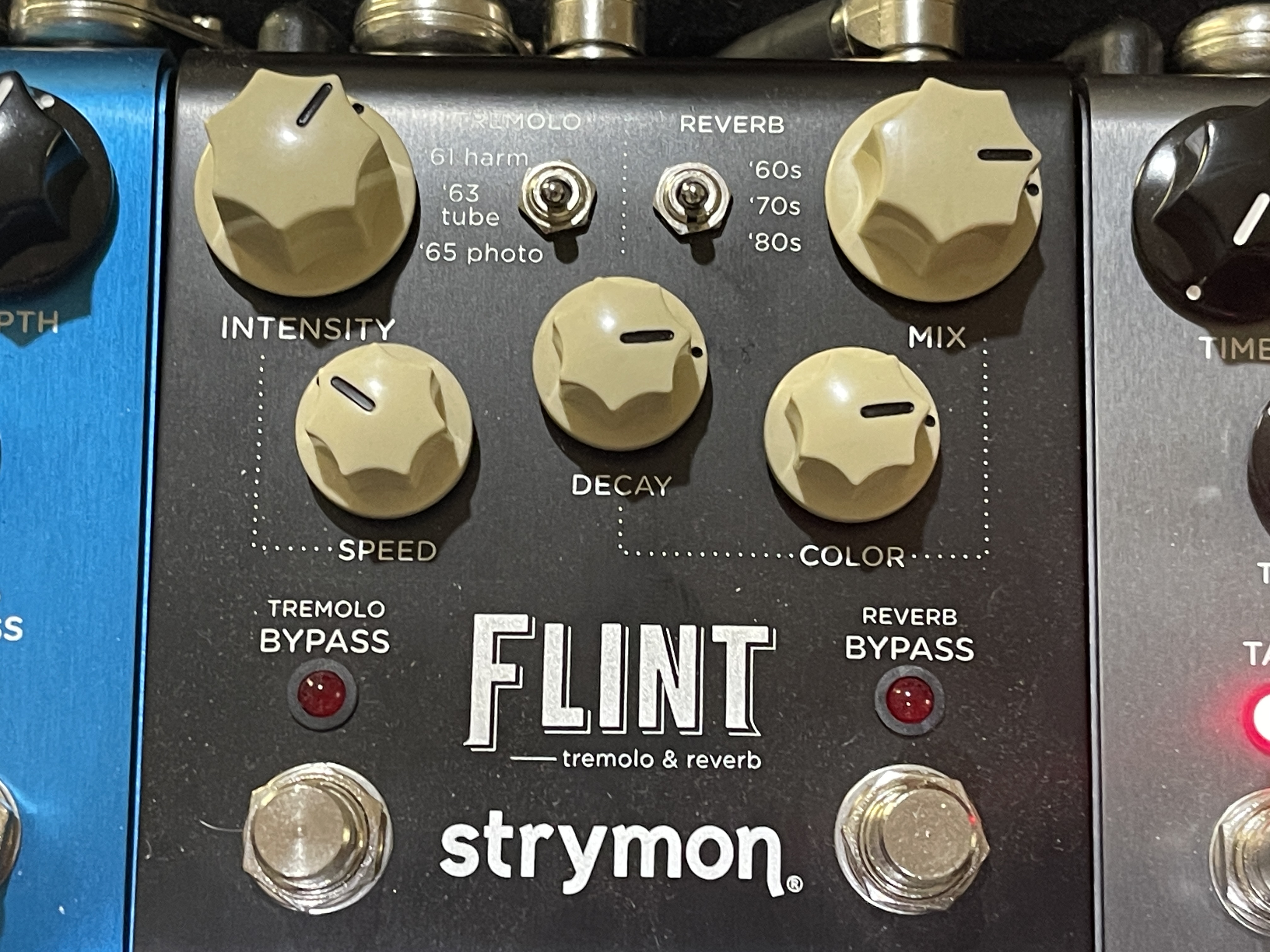
The Strymon Flint represents a masterclass in vintage effect emulation, housed in a compact pedal format that delivers professional-grade processing. This dual-engine processor combines tremolo and reverb effects inspired by classic amplifier circuits from the golden age of recorded music. I find the Strymon Flint adds life to a dry synth sound.
The tremolo side features three distinct modes that capture different eras of electronic music history. The ’61 Harmonic Tremolo delivers the complex amplitude and frequency modulation characteristic of early 1960s amplifiers. The ’63 Power Tube Tremolo provides the warm, tube-driven pulsing associated with mid-1960s designs. The ’65 Photocell Tremolo recreates the smooth, optical tremolo circuits that became popular in the latter half of the decade.
Each tremolo mode offers unique rhythmic characteristics and harmonic content that can dramatically transform static synthesizer patches. The harmonic tremolo creates subtle frequency filtering effects alongside amplitude modulation, while the power tube and photocell modes provide increasingly smooth and musical pulsing patterns.
The reverb section offers three equally distinctive flavors that span two decades of studio evolution. The ’60s Spring Tank emulation captures the splashy, mechanical character of the reverb springs found in guitar amplifiers and early electronic instruments. The ’70s Plate simulation recreates the smooth, dense reflections of the large metal plate reverbs used in professional recording studios. The ’80s Hall algorithm provides the spacious, ambient reflections associated with digital reverb processors that became standard during the DX7’s heyday.
Keyboard Sounds That Shine with the Flint
Electric piano patches represent perhaps the most obvious candidates for Strymon Flint processing. The DX7’s electric piano presets, while harmonically rich, benefit enormously from the addition of vintage tremolo and reverb effects. These processors add the shimmer and movement that make classic Rhodes and Wurlitzer sounds so appealing, transforming digital recreations into convincing vintage textures.
Brass sounds gain remarkable expressiveness when processed through Flint’s circuits. Static horn patches become animated and breathing, while reverb adds the spatial dimension that makes brass ensembles sound realistic and powerful. The combination of both effects can create lush, cinematic textures that elevate simple patches into professional-sounding arrangements.
Bass sounds, often overlooked for effects processing, can benefit significantly from subtle applications of reverb and tremolo. Light spring reverb adds dimension without muddying the low frequencies, while gentle tremolo can provide rhythmic interest that makes bass lines more engaging. The key lies in using these effects sparingly to enhance rather than overwhelm the fundamental frequencies.
String patches gain remarkable depth and movement through Flint processing. The DX7’s string sounds, while harmonically complex, often lack the natural swelling and spatial characteristics of acoustic string sections. Reverb provides essential ambience, while tremolo can simulate the natural vibrato and dynamic variation of live string players.
Clavinet sounds, with their percussive attack and bright harmonic content, pair exceptionally well with both tremolo and reverb effects. The tremolo adds funky rhythmic movement that enhances the instrument’s groove potential, while reverb can smooth the sometimes harsh digital edges without losing the characteristic bite that makes clavinet sounds so distinctive. I paired the Strymon Flint with a Clavecin patch on the DX7, and this was one of my favorite combinations.
Harmonium and organ patches benefit from the Flint’s ability to recreate vintage amplifier characteristics. These sounds historically relied on tube amplification and mechanical tremolo circuits for their characteristic warmth and movement. The Strymon Flint’s accurate emulations restore these essential sonic elements to digital recreations.
🎶 Buy Strymon Flint on Amazon 🎶
Practical Integration Techniques
Successfully integrating the Strymon Flint with your DX7 or dry synth requires attention to signal levels and effect balance. Start with subtle settings and gradually increase effect intensity until you achieve the desired character without overwhelming the original patch. The goal should be enhancement rather than transformation, unless dramatic effect processing serves your specific musical purpose.
Consider the musical context when selecting tremolo rates and reverb decay times. Faster tremolo rates work well for rhythmic passages but may clash with complex chord progressions. Similarly, long reverb tails create beautiful ambiences in sparse arrangements but can muddy busy musical textures.
Experiment with different combinations of tremolo and reverb modes to discover unique sonic possibilities. The interaction between these effects often produces unexpected and musical results that go beyond what either processor achieves independently.
Watch My YouTube Video – Strymon Flint with Yamaha DX7

🎶 Buy Strymon Flint on Amazon 🎶
Elevating Your Sound
Running your DX7 or dry synth through a Strymon Flint transforms sterile digital patches into living, breathing sounds that compete effectively with modern instruments. This combination breathes life, space, and character into classic digital tones, making vintage presets feel contemporary and relevant.
The investment in quality effects processing pays dividends in both recording and live performance contexts. Your patches gain professional polish and distinctive character that helps them cut through dense mixes while maintaining their essential musical qualities.
For musicians seeking to unlock the full potential of their DX7, the Strymon Flint represents an ideal gateway into the world of external effects processing. Its vintage-inspired algorithms complement the DX7’s retro aesthetic while providing the sonic enhancement that modern musical contexts demand. This pedal holds a special spot on my effects pedal board.
Thanks for stopping by to read this article about pairing the Strymon Flint with a dry synth or keyboard.
Arthur Dobrucki